

Before It Was Mine: What Has God Placed in Your Hands?

What if generosity begins not with what we give, but with recognizing everything we have already received?

Scripture: Psalm 24:1; Matthew 25:14–30

There is a word that tends to make people uncomfortable when it comes up in church: stewardship.

For many of us, it immediately brings money to mind. Giving, church budgets, fundraising campaigns, and conversations about how much we ought to contribute.

But Christian stewardship is about something much bigger than money. It is about how we understand our lives, what we do with what we have been given, and whether we trust God enough to live generously.

And perhaps the most important thing to understand about stewardship is this: it doesn’t begin with what we give. It begins with what we have received.

Before It Was Mine, It Was God’s

“The earth is the LORD’s and everything in it, the world and its inhabitants too.” — Psalm 24:1 (CEB)

Think about how often we use the word mine.

My house. My money. My time. My abilities. My plans. My life.

There is nothing inherently wrong with that language. We work hard, make decisions, and take responsibility for the things in our care. But Psalm 24 invites us to see our lives from a different perspective.

Before any of it was mine, it was God’s.

The breath we took this morning. The people we love. The abilities we have developed. The resources available to us. Even the hours that make up this day.

All of it is gift.

That changes the first question we ask about stewardship. Instead of beginning with “How much am I supposed to give?” we might begin with something far more meaningful:

What has God placed in my hands?

The Extraordinary Gift of Being Trusted

In Matthew 25:14–30, Jesus tells a story about a wealthy man preparing to leave on a journey. Before departing, he calls three servants together and entrusts his possessions to them.

One receives five talents, another receives two, and the third receives one.

A talent in Jesus’ day wasn’t a natural ability, as we commonly use the word today. It was an enormous amount of money, roughly equivalent to fifteen years of wages for an ordinary laborer.

Even the servant who received only one talent was entrusted with extraordinary wealth.

We often read this parable and immediately focus on what the servants did with the money. But before we consider their actions, it’s worth noticing what the master did.

He placed something incredibly valuable into their hands and gave them the freedom to do something with it.

Imagine approaching your own life from that perspective.

Instead of asking what God expects from you, consider what God has already entrusted to you.

Your time. Your relationships. Your experiences. Your creativity. Your compassion. Your financial resources. Your ability to encourage someone who is struggling. Perhaps even your own story of experiencing God’s grace.

Not everyone receives the same gifts or has access to the same resources. Our circumstances, opportunities, and responsibilities differ considerably.

But the invitation isn’t to compare what we have with what someone else possesses. It is to recognize what has been placed in our own hands and consider how we might use it faithfully.

Stewardship begins with recognizing that we are already standing in the middle of God’s generosity.

When Fear Makes Us Bury Our Gifts

In Jesus’ parable, the first two servants put their master’s money to work. The third servant takes a different approach.

He digs a hole and buries what he has received.

When the master returns and asks him to explain his decision, the servant offers a revealing answer:

“I was afraid.” (Matthew 25:25, CEB)

Fear shaped the way this servant understood his master, and fear determined what he did with the extraordinary gift entrusted to him.

It’s worth considering how often fear shapes our own decisions.

Sometimes fear tells us that what we have isn’t enough to make a difference. Sometimes it convinces us that someone else could do a better job. Sometimes it makes us reluctant to give because we worry that we might need those resources later.

We hesitate to reach out because we might be rejected. We avoid trying something new because we might fail. We hold back our compassion because caring deeply about someone makes us vulnerable.

Even churches and other organizations can become so concerned about preserving what they have that they lose sight of why those resources were entrusted to them in the first place.

We can protect something so carefully that we never actually use it.

Of course, faithfulness doesn’t mean recklessness. Wise stewardship requires discernment, responsible decisions, and attention to our own limitations.

But faith does involve risk.

We cannot love without risking being hurt. We cannot serve without accepting some inconvenience. We cannot give generously without releasing some control. And we cannot always follow God’s leading while knowing exactly where the path will take us.

Fear asks, “How can I keep this safe?”

Faith asks, “God, what can you do with this?”

The question isn’t simply whether we’ve preserved what God has given us. It’s whether we’ve trusted God enough to use it.

Grace Comes Before Generosity

There is a danger in reading the parable of the talents as nothing more than a command to work harder, accomplish more, or produce impressive results for God.

That interpretation can turn stewardship into another exhausting attempt to prove our worth.

But the Christian understanding of grace offers a different starting point.

We don’t live generously to earn God’s love. We live generously because we have already received it.

This truth is beautifully expressed in Holy Communion.

When Christians gather around Christ’s Table, we don’t come to demonstrate everything we’ve accomplished. We don’t come because we’ve used every gift perfectly or finally gotten our lives together.

We come because Christ invites us.

We come with empty hands, ready to receive.

In the Gospels, Jesus takes bread, blesses it, breaks it, and gives it to the disciples (Luke 22:19). That simple act of giving becomes central to the Christian understanding of God’s grace.

Communion reminds us that our relationship with God begins not with our accomplishments but with Christ’s generosity.

And this is a gift shared by Christians across the world. On World Communion Sunday, many congregations celebrate this connection, remembering that people from different nations, cultures, languages, and economic circumstances are united through Christ.

Some gather in magnificent sanctuaries. Others gather in modest churches, homes, or places where practicing their faith requires considerable courage.

Some come with abundance. Others know intimately what it means to go without.

Yet all come to receive the grace of God.

As Ephesians 2:8–10 reminds us, we are saved by grace through faith, not by our own accomplishments, and we are created in Christ Jesus for good works.

Grace comes first. Our response follows.

And perhaps knowing that we are already loved gives us the courage to loosen our grip on what we have.

The hands that receive God’s grace can become hands that share God’s grace.

What Will You Plant?

Consider a seed.

If your only goal were to keep a seed safe, you could place it in a container, protect it from the weather, and make sure nothing disturbed it.

It would remain safe.

But it would never become what it was created to become.

For a seed to grow, it must eventually be planted. It must be released into the soil, where growth can begin.

Jesus uses a similar image in John 12:24, describing how a grain of wheat must fall into the earth for new life to emerge.

Perhaps the same is true of the gifts God has entrusted to us.

Our time, compassion, abilities, relationships, and resources were never intended simply to be buried and kept safe. They are opportunities for God’s grace to take root and grow in the world.

That doesn’t mean we need to do everything, give everything away, or ignore our own needs. It means becoming more attentive to the opportunities already in front of us.

Perhaps there is a gift you’ve been hesitant to use. Someone you’ve been meaning to contact. An opportunity to serve that you’ve been reluctant to explore. A resource you could share. A step you’ve been afraid to take.

Perhaps there’s simply some part of your life you’ve been holding so tightly that God is inviting you to loosen your grip.

You don’t need to have five talents. You don’t need to possess what someone else has. And you don’t need to accomplish something extraordinary to make a meaningful difference.

You can begin with what God has already placed in your hands.

Christian stewardship, at its deepest, isn’t about accumulating accomplishments or proving ourselves worthy of God’s generosity. It’s about recognizing that everything we have is a gift and discovering how those gifts can become expressions of love.

It’s all gift. It’s all grace. And it’s all entrusted to us.

What has God placed in your hands, and what might happen if you trust God enough to plant it?

For further reflection: Read Psalm 24:1, Matthew 25:14–30, Luke 22:14–20, Ephesians 2:8–10, and John 12:24.

Before It Was Mine: What Has God Placed in Your Hands?

What if generosity begins not with what we give, but with recognizing everything we have already received?

Scripture: Psalm 24:1; Matthew 25:14–30

There is a word that tends to make people uncomfortable when it comes up in church: stewardship.

For many of us, it immediately brings money to mind. Giving, church budgets, fundraising campaigns, and conversations about how much we ought to contribute.

But Christian stewardship is about something much bigger than money. It is about how we understand our lives, what we do with what we have been given, and whether we trust God enough to live generously.

And perhaps the most important thing to understand about stewardship is this: it doesn’t begin with what we give. It begins with what we have received.

Before It Was Mine, It Was God’s

“The earth is the LORD’s and everything in it, the world and its inhabitants too.” — Psalm 24:1 (CEB)

Think about how often we use the word mine.

My house. My money. My time. My abilities. My plans. My life.

There is nothing inherently wrong with that language. We work hard, make decisions, and take responsibility for the things in our care. But Psalm 24 invites us to see our lives from a different perspective.

Before any of it was mine, it was God’s.

The breath we took this morning. The people we love. The abilities we have developed. The resources available to us. Even the hours that make up this day.

All of it is gift.

That changes the first question we ask about stewardship. Instead of beginning with “How much am I supposed to give?” we might begin with something far more meaningful:

What has God placed in my hands?

The Extraordinary Gift of Being Trusted

In Matthew 25:14–30, Jesus tells a story about a wealthy man preparing to leave on a journey. Before departing, he calls three servants together and entrusts his possessions to them.

One receives five talents, another receives two, and the third receives one.

A talent in Jesus’ day wasn’t a natural ability, as we commonly use the word today. It was an enormous amount of money, roughly equivalent to fifteen years of wages for an ordinary laborer.

Even the servant who received only one talent was entrusted with extraordinary wealth.

We often read this parable and immediately focus on what the servants did with the money. But before we consider their actions, it’s worth noticing what the master did.

He placed something incredibly valuable into their hands and gave them the freedom to do something with it.

Imagine approaching your own life from that perspective.

Instead of asking what God expects from you, consider what God has already entrusted to you.

Your time. Your relationships. Your experiences. Your creativity. Your compassion. Your financial resources. Your ability to encourage someone who is struggling. Perhaps even your own story of experiencing God’s grace.

Not everyone receives the same gifts or has access to the same resources. Our circumstances, opportunities, and responsibilities differ considerably.

But the invitation isn’t to compare what we have with what someone else possesses. It is to recognize what has been placed in our own hands and consider how we might use it faithfully.

Stewardship begins with recognizing that we are already standing in the middle of God’s generosity.

When Fear Makes Us Bury Our Gifts

In Jesus’ parable, the first two servants put their master’s money to work. The third servant takes a different approach.

He digs a hole and buries what he has received.

When the master returns and asks him to explain his decision, the servant offers a revealing answer:

“I was afraid.” (Matthew 25:25, CEB)

Fear shaped the way this servant understood his master, and fear determined what he did with the extraordinary gift entrusted to him.

It’s worth considering how often fear shapes our own decisions.

Sometimes fear tells us that what we have isn’t enough to make a difference. Sometimes it convinces us that someone else could do a better job. Sometimes it makes us reluctant to give because we worry that we might need those resources later.

We hesitate to reach out because we might be rejected. We avoid trying something new because we might fail. We hold back our compassion because caring deeply about someone makes us vulnerable.

Even churches and other organizations can become so concerned about preserving what they have that they lose sight of why those resources were entrusted to them in the first place.

We can protect something so carefully that we never actually use it.

Of course, faithfulness doesn’t mean recklessness. Wise stewardship requires discernment, responsible decisions, and attention to our own limitations.

But faith does involve risk.

We cannot love without risking being hurt. We cannot serve without accepting some inconvenience. We cannot give generously without releasing some control. And we cannot always follow God’s leading while knowing exactly where the path will take us.

Fear asks, “How can I keep this safe?”

Faith asks, “God, what can you do with this?”

The question isn’t simply whether we’ve preserved what God has given us. It’s whether we’ve trusted God enough to use it.

Grace Comes Before Generosity

There is a danger in reading the parable of the talents as nothing more than a command to work harder, accomplish more, or produce impressive results for God.

That interpretation can turn stewardship into another exhausting attempt to prove our worth.

But the Christian understanding of grace offers a different starting point.

We don’t live generously to earn God’s love. We live generously because we have already received it.

This truth is beautifully expressed in Holy Communion.

When Christians gather around Christ’s Table, we don’t come to demonstrate everything we’ve accomplished. We don’t come because we’ve used every gift perfectly or finally gotten our lives together.

We come because Christ invites us.

We come with empty hands, ready to receive.

In the Gospels, Jesus takes bread, blesses it, breaks it, and gives it to the disciples (Luke 22:19). That simple act of giving becomes central to the Christian understanding of God’s grace.

Communion reminds us that our relationship with God begins not with our accomplishments but with Christ’s generosity.

And this is a gift shared by Christians across the world. On World Communion Sunday, many congregations celebrate this connection, remembering that people from different nations, cultures, languages, and economic circumstances are united through Christ.

Some gather in magnificent sanctuaries. Others gather in modest churches, homes, or places where practicing their faith requires considerable courage.

Some come with abundance. Others know intimately what it means to go without.

Yet all come to receive the grace of God.

As Ephesians 2:8–10 reminds us, we are saved by grace through faith, not by our own accomplishments, and we are created in Christ Jesus for good works.

Grace comes first. Our response follows.

And perhaps knowing that we are already loved gives us the courage to loosen our grip on what we have.

The hands that receive God’s grace can become hands that share God’s grace.

What Will You Plant?

Consider a seed.

If your only goal were to keep a seed safe, you could place it in a container, protect it from the weather, and make sure nothing disturbed it.

It would remain safe.

But it would never become what it was created to become.

For a seed to grow, it must eventually be planted. It must be released into the soil, where growth can begin.

Jesus uses a similar image in John 12:24, describing how a grain of wheat must fall into the earth for new life to emerge.

Perhaps the same is true of the gifts God has entrusted to us.

Our time, compassion, abilities, relationships, and resources were never intended simply to be buried and kept safe. They are opportunities for God’s grace to take root and grow in the world.

That doesn’t mean we need to do everything, give everything away, or ignore our own needs. It means becoming more attentive to the opportunities already in front of us.

Perhaps there is a gift you’ve been hesitant to use. Someone you’ve been meaning to contact. An opportunity to serve that you’ve been reluctant to explore. A resource you could share. A step you’ve been afraid to take.

Perhaps there’s simply some part of your life you’ve been holding so tightly that God is inviting you to loosen your grip.

You don’t need to have five talents. You don’t need to possess what someone else has. And you don’t need to accomplish something extraordinary to make a meaningful difference.

You can begin with what God has already placed in your hands.

Christian stewardship, at its deepest, isn’t about accumulating accomplishments or proving ourselves worthy of God’s generosity. It’s about recognizing that everything we have is a gift and discovering how those gifts can become expressions of love.

It’s all gift. It’s all grace. And it’s all entrusted to us.

What has God placed in your hands, and what might happen if you trust God enough to plant it?

For further reflection: Read Psalm 24:1, Matthew 25:14–30, Luke 22:14–20, Ephesians 2:8–10, and John 12:24.

Who Is God? Finding Evidence in Love

This past Sunday, we began our Lenten sermon series, “Questions to God,” by wrestling with one of the biggest and most fundamental questions of faith: Who is God? And does God even exist?

For centuries, people have sought proof of God’s presence. We long for certainty, something tangible we can see, hear, or touch. But faith doesn’t always work that way. Instead of giving us definitive answers, God gives us an invitation—an invitation to love.

Seeking God in Love

Psalm 103 speaks of a God who is compassionate, slow to anger, and overflowing with steadfast love. But how do we really know this is true? If we can’t physically see God, how can we be sure God is real?

1 John 4 offers a bold response: “God is love.”

This means that whenever we experience true, selfless love, we are catching a glimpse of God. We see God in the embrace of a friend who comforts us in sorrow, in the patience of a parent teaching a child, in the kindness of a stranger who extends help without expectation.

This idea is echoed in the words of Mother Teresa when a journalist once asked her, “Where is God?”

She replied:
“God is in the smile you give a child. God is in the hand you hold of someone who is suffering. God is in the small acts of love that go unnoticed but make all the difference in the world.”

Her response is simple, yet profound: if you want to see God, look for love.

Is Love Really Enough?

But that raises a difficult question: Is love really enough?

If we’re honest, sometimes we want more than just an idea. We want certainty. We want proof. And we are not alone in this struggle—the Bible is full of people who asked for the same thing.

  • Moses asked to see God’s glory.
  • The disciples wanted Jesus to show them the Father.
  • Thomas refused to believe in the resurrection until he could touch Jesus’ scars.

Yet, in all these cases, God’s response was not always physical proof but relationship, presence, and love.

1 John 4:12 reminds us: “No one has ever seen God. But if we love each other, God remains in us and God’s love is made complete in us.”

To know love is to know God.

Jesus: The Ultimate Revelation of God’s Love

But how do we know that love comes from God? Couldn’t love just be a human instinct, a biological reaction, or a cultural value we’ve learned?

This is where Jesus changes everything.

1 John 4:9-10 tells us that God’s love was made known through Jesus.

Yes, people can experience love apart from faith, but in Jesus, something radical and new happened. His love went beyond emotion, beyond instinct, beyond even survival.

His love was:

  • Sacrificial – Giving up his own comfort and safety for the sake of others.
  • Self-giving – Holding nothing back, even his own life.
  • Countercultural – Welcoming outsiders, forgiving enemies, and loving without condition.

Jesus showed a love that:

  • Forgave even those who crucified him.
  • Healed the broken.
  • Welcomed those the world had rejected.
  • Gave everything—even his own life—for the sake of others.

And after his death, something remarkable happened.

A New Kind of Community

A new community emerged—a group of people who had once been afraid but were now radically loving, deeply unified, and completely transformed.

In Acts 4:32-36, we see what this community looked like:

  • They shared everything.
  • They cared for the poor.
  • They lived without fear.
  • They were freed from oppressive systems.

This was not just a social movement—it was the love of God at work.

And that same love is still at work today.

Where Have You Seen God’s Love?

Love is not just an abstract concept—it’s something deeply personal.

For me, one of the greatest examples of love in my life was my grandmother. I met her for the first time when I was three years old, and I will never forget that moment. As soon as she saw me and my mother, she wrapped us both in her arms, as if we had always belonged to her.

Never once did she make me feel like an outsider. She loved me as if I was her own. It was as if, before that moment, I had been lost—but in her embrace, I had finally found home.

That kind of love tells you that you belong, that you are wanted, that you are cherished.

And when I look back, I realize—that kind of love wasn’t just human love. That was divine.

A Call to Live Differently

1 John 4:18 says, “There is no fear in love, but perfect love drives out fear.”

We live in a world that is often driven by fear—fear of failure, fear of rejection, fear of those who are different from us, fear of not having enough.

But what if we, as a church, chose to abide in love instead?
What if we didn’t let fear have the final word?
What if, instead of trying to prove ourselves, defend ourselves, or protect ourselves, we simply loved?

Imagine What Could Happen…

  • Instead of judging, we showed grace.
  • Instead of reacting in anger, we responded with patience.
  • Instead of assuming the worst, we gave the benefit of the doubt.
  • Instead of withholding forgiveness, we extended it freely.

What would our families look like if we chose love over fear?
What would our workplaces feel like if we lived as people of grace?
What would our neighborhoods, schools, and communities become if we truly believed that love—not power, not control, not fear—is the greatest evidence of God?

The Challenge for This Week

So, here is the challenge:

  • Where have you seen love at work this week?
  • Where is God calling you to be a reflection of that love?
  • What fear, bitterness, or hesitation do you need to let go of so you can love more freely?

Because the world doesn’t just need to hear about love.
The world needs to see it.
The world needs to experience it.
The world needs to find home in it.

And that starts with us.

Let’s be a church where love is so bold, so undeniable, that when people look at us, they don’t just see us—they see God.


Closing Prayer

Loving God,
We may not see you with our eyes, but we see you in the love that surrounds us.
Help us to trust that love is not just an emotion but a reflection of your presence.
Make us people who love boldly, without fear, without hesitation.
Let our lives be a witness to your goodness, your mercy, and your grace.
In Jesus’ name, Amen.


Want to Dive Deeper?

  • Reflect: Write down one way you have seen love in action today.
  • Act: Who in your life needs to experience God’s love through you? Take one intentional step to show them grace, kindness, or compassion this week.

***

Hands to Serve, Hearts to Love

1 The earth is the LORD’s and everything in it,
the world and its inhabitants too.
2 Because God is the one who established it on the seas;
God set it firmly on the waters.
3 Who can ascend the LORD’s mountain?
Who can stand in his holy sanctuary?
4 Only the one with clean hands and a pure heart;
the one who hasn’t made false promises,
the one who hasn’t sworn dishonestly.
5 That kind of person receives blessings from the LORD
and righteousness from the God who saves.
6 And that’s how things are
with the generation that seeks him—
that seeks the face of Jacob’s God. ~Psalms 24:1-6

Psalm 24 reminds us that the earth belongs to God, and so do we. With that truth comes responsibility—to care for creation and for each other. The psalm also asks, “Who may stand before the Lord?” The answer? “Those with clean hands and pure hearts.”

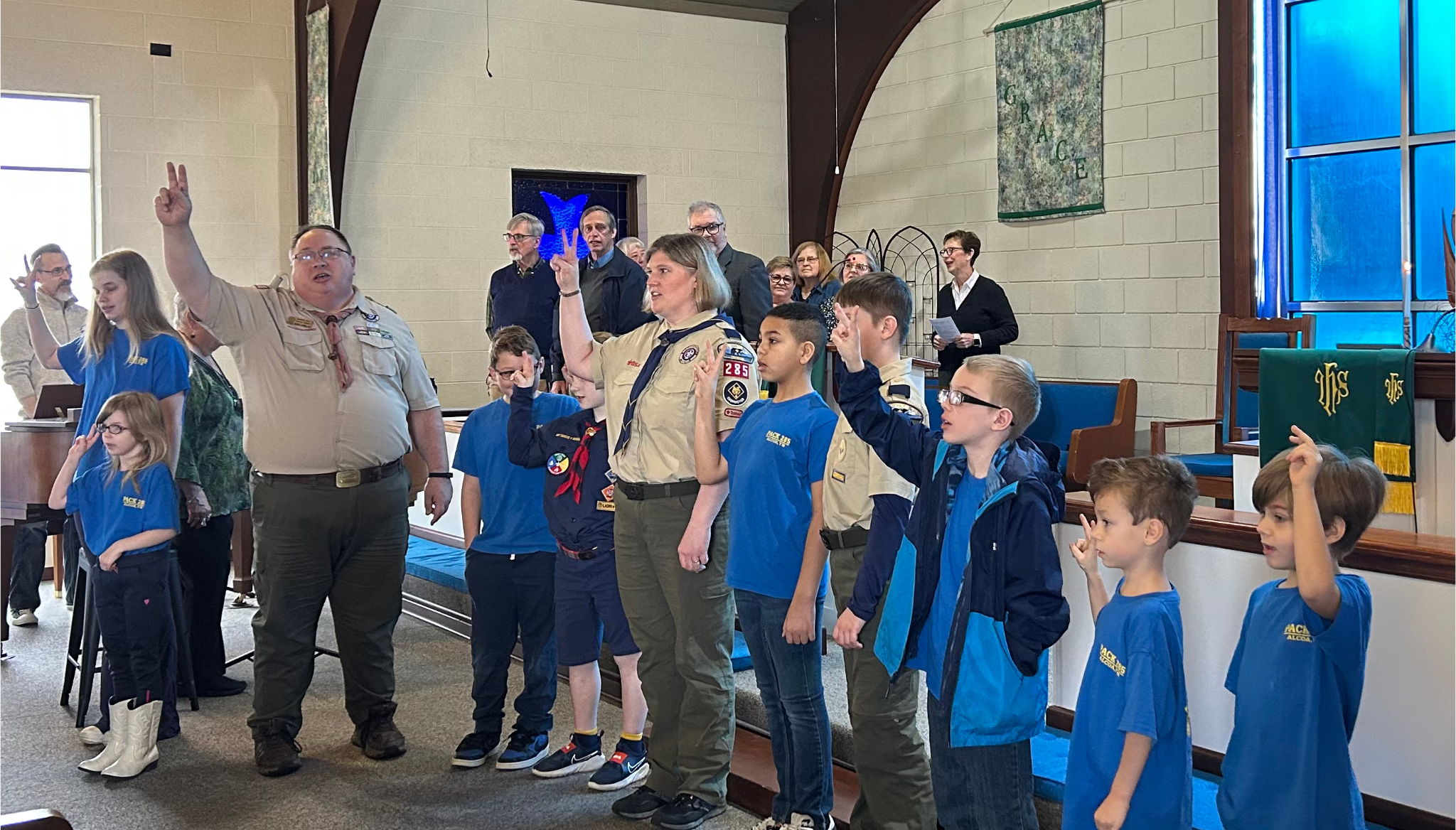
On Sunday, we celebrated Scout Sunday, reflecting on these values of stewardship, service, and honor. The Scout Oath and Law call young people to live with integrity, to help others, and to be reverent. These same principles are at the core of our faith – because living a life that honors God isn’t just about what we believe; it is about how we live.

But what does this look like in our daily lives? How do we live with clean hands – serving others with purpose? How do we cultivate pure hearts – loving God fully and loving our neighbors with sincerity?

For that answer, we turn to the words of Jesus in the Gospel of Matthew. When asked what commandment is the greatest, Jesus does not respond with a long list of rules or religious rituals. Instead, he gives us something deep yet simple.

“Love the Lord God with all your heart, soul, and mind. And love your neighbor as yourself.”

If Psalm 24 calls us to have clean hands and pure hearts, then Matthew 22 shows us what that truly means: our hands are meant to serve, and our hearts are meant to love…

36 “Teacher, what is the greatest commandment in the Law?”
37 He replied, “You must love the Lord your God with all your heart, with all your being, and with all your mind. 38 This is the first and greatest commandment. 39 And the second is like it: You must love your neighbor as you love yourself. 40 All the Law and the Prophets depend on these two commands.” ~Matthew 22:36-40

Sometimes, we care a lot about how we look on the outside – what we wear, what we say, and what other people think about us. It is like spending all our time cleaning a mirror to make it shiny, but never actually getting ourselves ready. But Psalm 24 reminds us that what really matters is what is inside – having clean hands and a pure heart.

Now, let’s think about work gloves. Gloves aren’t meant to stay clean. A brand-new pair of gloves sitting on a shelf look nice, but they aren’t fulfilling their purpose. Gloves are meant to get dirty, worn, and used for work. They are meant for planting gardens, building homes, helping others – they are meant for service.

Our faith isn’t about looking good – it is about getting our hands to work in service. That is exactly what Jesus tells us in Matthew 22: love God with everything you have, and love your neighbor as yourself. That love isn’t just a feeling – it’s an action. Just like a pair of gloves isn’t useful unless it is used for work, our faith isn’t complete unless it is put into action through serving others and living with integrity.

Psalm 24 tells us that only those with clean hands and pure hearts may stand before God. But clean hands don’t mean hands that have never touched dirt. They mean hands that have worked, helped, and served. Hands that have been used for Good.
Scouts have a simple slogan: “Do a Good Turn Daily.” It is a reminder that acts of service don’t have to be big projects, big sacrifices, or life-changing actions.

But often, love is seen in the small things. Holding the door for someone. Saying thank you and showing kindness. Sitting with someone who is alone. Picking up trash, even if you didn’t drip it. Calling a friend or relative who might be lonely. You don’t need to change the whole world to show love – you just need to change a moment for someone.

One day, a man was walking down the street when he saw a young boy helping an older man carry groceries to his car. The boy wasn’t asked – he just saw someone struggling and stepped in. The man watching smiles and said, “that was very kind of you!” The boy shrugged and said, “IT’s just what we are supposed to do, right?”

If clean hands mean serving with purpose, then a pure heart means serving with the right motives. Jesus says the greatest commandment is to love the Lord your God with all your heart, soul, and mind. Loving God isn’t just about believing the right things – its about giving our hearts fully to God in everything we do.

Do we help others so that people will see us? Do we do good things only when we will get something in return? Or do we love and serve because God loves us first Sometimes, we get so caught up in how we look or what we get out of it that we forget the real purpose of love and service. 1 Corinthians 13:3 says, “If I give away everything that I have and hand over my own body to feel good about what I’ve done but I don’t have love, I receive no benefit whatsoever.” Serving without love is just empty action.

We have spent time looking at Psalm 24’s call to have clean hands and pure hearts and Jesus’ command in Matthew 22 to love God and love our neighbor. Now we will bring it all together.
In Matthew 22:40, Jesus says, “All the Law and Prophets hang on these two commandments.”
This means that everything God has ever taught us – every command, every law, every act of worship – boils down to two things: Loving God with all we are and loving others as ourselves. It is that simple. If we get this right, everything else falls into place. But here is the challenge. We can do a lot of things right and still miss the point if we don’t love.

We can attend church every Sunday but if we don’t love our neighbor, we have missed the point. We can pray beautiful prayers but if we refuse to help someone in need, we have missed the point. We can know every Bible verse by heart, but if we don’t show kindness, patience, and generosity, we have missed the point. We can follow all the rules but if our hearts aren’t filled with love for God and others, we have missed the point. This is why Jesus places love at the center of our faith. Without it, everything else is empty.

Let’s return to the work gloves analogy. If we leave our gloves on a shelf, clean and unused, they serve no purpose. If we only wear them to look the part but never do the work, we aren’t really serving. But if we put them on, get to work, and serve with love, we are fulfilling our purpose. This is what Jesus calls us to do.

Are we just polishing the mirror – worried about how we appear to others? Or are we putting on our gloves and getting to work – showing love in action? Faith is meant to be lived out. Our love for God is meant to be seen in how we treat others. Clean hands and pure hearts aren’t about being perfect. They are about being willing to serve, love, and follow God with sincerity.

We began today with a question from Psalm 24: “Who may ascend the mountain of the Lord? Who may stand in his holy place?” And we found our answer: Those with clean hands and pure hearts. Then, we heard the words of Jesus in Matthew 22: “Love the Lord your God with all your heart, soul, and mind, and love your neighbor as yourself.” This is what truly matters. This is what we are called to do. But where do we go from here? How do we actually live this out?

The Scout motto is “Be Prepared.” A scout is always ready – ready to help, ready to serve, ready to do what is needed. As followers of Christ, we must also be prepared – prepared to love when it is inconvenient, prepared to serve when it is not easy, prepared to answer when God calls. Being prepared doesn’t mean waiting for a big, perfect opportunity – it means being ready every day to do good wherever we are. Are we prepared to love? Are we prepared to serve? Are we prepared to live as Jesus taught?

The Cub Scout motto is “Do Your Best.” Jesus doesn’t ask us to be perfect – he asks us to do our best. Loving God with all our heart, soul, and mind doesn’t mean we have to get everything right – it means we give our best effort every day. Loving our neighbor doesn’t mean we always have to do something huge – it means we do what we can, when we can, with a willing heart.

So the challenge is simple:

Do your best to serve. Do your best to love. Do your best to live as Jesus calls us to.

Imagine what our world would look like if every person committed to: Keeping their hands clean by using them for service. Keeping their hearts pure by filling them with love. Being prepared to answer when God calls. Doing their best to love God and love their neighbor. If we lived this way, we wouldn’t just hear the greatest commandments – we would live them.

So, let’s make a commitment:

With our hands, we will serve. With our hearts, we will love. We will be prepared. We will do our best.

And when we do, we will truly be the kind of people God calls us to be. Amen.

In search of a star

When they saw that the star had stopped, they were overwhelmed with joy. On entering the house, they saw the child with Mary his mother; and they knelt down and paid him homage. Then, opening their treasure chests, they offered him gifts of gold, frankincense, and myrrh. And having been warned in a dream not to return to Herod, they left for their own country by another road. Matthew 2:10-12 (CEB)

Today is the 12th day of Christmas. Tradition tells us that this is when the Wisemen arrived to see the baby Jesus. How did the Wisemen know that Jesus had been born? The Wisemen knew that something was about to happen because they had been watching. They weren’t distracted by things going on around them. They were intently looking. Not only did they notice that the star began its move they also followed.

There is much I can learn from the Wisemen. I can learn to patiently watch and listen as God reveals His vision for my life. Sometimes, even when I try hard to do so, I just don’t see God in the everyday things and events. But I think this is why we are given the story of the Wisemen.

Epiphany gives me the time to remember to watch, wait, listen, look, anticipate, and discern the light, life and truth of the Lord’s presence in my midst. It reminds me that it is important that I remember to look for Him in my life. It is vital that we remember to watch. Once I see His presence in my life I should not return to who I was before. I must seek a new path for my life. How applicable that this story comes so near to the first of the year with its opportunity of a fresh start!

Dear God, Thank you for second chances and for new beginnings. Thank You for signs in our life that show us the way to go. Help me to go down a different path this year. Help me to search for you in even the smallest moments. Help me in my search to be transformed through Your never endig grace. Amen.

What’s there to hold on to

So what are we going to say about these things? If God is for us, who is against us? He didn’t spare his own Son but gave him up for us all. Won’t he also freely give us all things with him? Who will bring a charge against God’s elect people? It is God who acquits them. Who is going to convict them? It is Christ Jesus who died, even more, who was raised, and who also is at God’s right side. It is Christ Jesus who also pleads our case for us. Who will separate us from Christ’s love? Will we be separated by trouble, or distress, or harassment, or famine, or nakedness, or danger, or sword? As it is written, “We are being put to death all day long for your sake. We are treated like sheep for slaughter.”

But in all these things we win a sweeping victory through the one who loved us. I’m convinced that nothing can separate us from God’s love in Christ Jesus our Lord: not death or life, not angels or rulers, not present things or future things, not powers or height or depth, or any other thing that is created. ~Romans 8:31-39 (CEB)


“Life is unpredictable.  We can be happy one day and sad the next, healthy one day and sick the next, rich one day and poor the next, alive one day and dead the next.  So who is there to hold on to?  Who is there to feel secure with?  Who is there to trust at all times?

Only Jesus, the Christ.  He is our Lord, our shepherd, our rock, our stronghold, our refuge, our brother, our guide, and our friend.  He came from God to be with us.  He died for us, he was raised from the dead to open for us the way to God, and he is seated at God’s right hand to welcome us home.   With Paul, we must be certain that “neither death nor life, nor angels, nor principalities, nothing already in existence and nothing still to come, nor any power, nor the heights nor the depths, nor any created thing whatever, will be able to come between us and the love of God, known to us in Christ Jesus our Lord”  (Romans 8:38-39).” ~From Bread for the Journey by Henri J.M. Nouwen

A New Year looms ahead. The possibilities are endless. Sadness and happiness are mixed at the close of an old year; anxiety and excitement greet the New Year. What will it hold? For most there is the underlying hope that the New Year will be better. I may not know what tomorrow and the New Year will bring but I do know that Jesus came down from God to hold my hand through whatever I face, both the good times and the bad.

Merry Christmas!

I ask you Heavenly Father to walk with me into this New Year. I welcome Your Presence in my life. I thank You for the gift of Your Son to guide and direct my steps as I enter the New Year with a clean slate of possibilities. May I ever hold close the belief that You will use all things for my good. Amen.

Arise and Shine!

Arise! Shine! Your light has come; the LORD’s glory has shone upon you. Though darkness covers the earth and gloom the nations, the LORD will shine upon you; God’s glory will appear over you. Nations will come to your light and kings to your dawning radiance. ~Isaiah 60:1-3

“It requires a lot of inner solitude and silence to become aware of these divine movements. God does not shout, scream or push. The Spirit of God is soft and gentle like a small voice or a light breeze. It is the spirit of love. Maybe we still do not fully believe that God’s Spirit is, indeed, the Spirit of love, always leading us deeper into love. Maybe we still distrust the Spirit, afraid to be led to places where our freedom is taken away. Maybe we still think of God’s Spirit as an enemy who wants something of us that is not good for us.

But God is love, only love, and God’s Spirit is the Spirit of love longing to guide us to the place where the deepest desires of our heart can be fulfilled. Often we ourselves do not even know what our deepest desire is. We so easily get tangled in our own lust and anger, mistakenly assuming that they tell us what we really want. The Spirit of love says: ‘Don’t be afraid to let go of your need to control your own life. Let me fulfill the true desire of your heart.” ~From Here and Now by Henri J. M. Nouwen

Jesus came into the world so that I don’t have to hold onto control so tightly. He knows the real desires of my heart and only wants good for me. He sent Jesus into the world so that I could begin to see beyond the “Thou shalt not’s” to the freedom He desires for me.

Merry Christmas!

It is the call of my heart God to be close to You. Your whispering is heard as it blows through my heart giving me new life. Bolster my unbelief so that I may live life more fully. Give me freedom instead of the chains that bind me to a life I don’t want. Help me to live in the Freedom you promise if only I believe. Help me this day to rise and shine for You. Amen.  

O little town

In those days Caesar Augustus declared that everyone throughout the empire should be enrolled in the tax lists. This first enrollment occurred when Quirinius governed Syria. Everyone went to their own cities to be enrolled. Since Joseph belonged to David’s house and family line, he went up from the city of Nazareth in Galilee to David’s city, called Bethlehem, in Judea. He went to be enrolled together with Mary, who was promised to him in marriage and who was pregnant. While they were there, the time came for Mary to have her baby. She gave birth to her firstborn child, a son, wrapped him snugly, and laid him in a manger, because there was no place for them in the guestroom. ~Luke 2:1-7 (CEB)

O LITTLE TOWN OF BETHLEHEM

by, Phillip Brooks, Lewis H. Redner.

O little town of Bethlehem,

How still we see thee lie;

Above thy deep and dreamless sleep,

The silent stars go by.

Yet in thy dark streets shineth

The everlasting light;

The hopes and fears of all the years

Are met in thee tonight.

For Christ is born of Mary,

And gather’d all above

While mortals sleep, the angels keep

Their watch of wond’ring love.

O morning stars together

Proclaim the holy birth

And praises sing to God the King

And peace to men on earth.

“No matter how often we sing them, the simple words and music of Phillip Brooks’ ‘O Little Town of Bethlehem’ transport us to that night in which the Christ child came to earth. Through a gentle, quiet tune and pictures made by words, we enter the time and place when God, transcendent and unfathomable, was born into human history- in a human way. In terms a human being could best understand.

As the carol proceeds, our words become a prayer. It is a prayer that asks for something incredible: that the miracle be reproduced, and that this time, the event not simply happened in history, but in us.” ~From Faith, the Yes of the Heart by Grace Adolphsen Brame

Peace on earth seems so far away sometimes Heavenly Father, I am thankful for the retelling of the Christmas story because it reminds me that You were willing to come down here with us on Earth. Although the world doesn’t seem peaceful and quiet, if I turn to You I can always find that peace that passes this present understanding. Amen.

Let it be as You have said

Then Mary said, “I am the Lord’s servant. Let it be with me just as you have said.” Then the angel left her. ~Luke 1:38 (CEB)

“We know we are entirely dependent upon God, yet we forget and try to make our own provision for tomorrow or waste our energy in anxiety and fear that we will be forsaken when tomorrow comes. Mary was able to trust her life fully to the everlasting arms, sure that she would be upheld no matter what the future brought. ‘I am yours’. Help me to remember you provided for me as a helpless baby: you provide for me now and will provide for me through eternal ages. Help me to live as one life totally given to you.” ~From A guide to Prayer for All Who Seek God, Rueben P. Job

Heavenly Father, I know deep in my heart that You will provide all my needs, especially as I try to walk in obedience to your will. Guide my steps, strengthen my will, hold my hand as I try to walk this day for You, I am Yours. Amen.

One long night…

Nearby shepherds were living in the fields, guarding their sheep at night. The Lord’s angel stood before them, the Lord’s glory shone around them, and they were terrified. The angel said, “Don’t be afraid! Look! I bring good news to you—wonderful, joyous news for all people. Your savior is born today in David’s city. He is Christ the Lord. This is a sign for you: you will find a newborn baby wrapped snugly and lying in a manger. ” Suddenly a great assembly of the heavenly forces was with the angel praising God. They said, “Glory to God in heaven, and on earth peace among those whom he favors.”

When the angels returned to heaven, the shepherds said to each other, “Let’s go right now to Bethlehem and see what’s happened. Let’s confirm what the Lord has revealed to us. ” They went quickly and found Mary and Joseph, and the baby lying in the manger. When they saw this, they reported what they had been told about this child. Everyone who heard it was amazed at what the shepherds told them. Mary committed these things to memory and considered them carefully. The shepherds returned home, glorifying and praising God for all they had heard and seen. Everything happened just as they had been told. ~Luke 2:8-20 (CEB)

Christmas is supposed to be a time of joy. Isn’t it? TV shows and commercials illustrate Christmas time as the … “most wonderful time of the year…” So if Christmas makes you blue… (now I have Evis singing in my head) or even flat out depressed it can be isolating in the sea of celebrations. It can leave some people gloomy finding the holidays anything but jolly, while still others will have experiences that make it difficult to be merry and bright.

When I think of the Advent story it seems to me to start out in the dark and cold, even in the midst of hopelessness. But it is also part of a bigger story of God’s grace waiting our discovery. It is a story of hope.

Sometimes the hype and clichés of the season distract us. The clever marketing ploys succeed in making us desire tangible things we can hold in our hands. Marketing gives us false illusions of how we can find happiness. However all the marketing efforts, hype and catchy logos cannot answer the deep questions of the heart, or address the pain that might reside there, explain the mystery of God’s presence, or even comprehend the meaning of our existence. It also does not help us to understand why bad things happen.

Advent can give us hope though in the midst of our isolation and false illusions because it tells us a story of how God humbled himself, intimately and personally through the birth of Jesus. Sometimes we blow off Advent as just another blip on the church calendar but it is meant to be something more. It is meant to lay a new path of faith for the new year ahead.

In the remembering and retelling of the magical story we are reminded that God loved us so much he allowed Jesus to come down here in the form of a fragile infant to be born in the lowliest of places. The retelling of the story is to remind me why Jesus came into the world in the first place, so that I might have life and live in the light.  I am reminded with the Advent story that God is a hands-on God willing to become vulnerable just so that I might catch a glimpse of how much He loves me. This story tells me that Jesus loved me so much that he came down to earth to be in the darkness with me and to walk with me as I search for the light.

Advent is meant to confront me once again with God’s unparalleled effort to communicate the message that I am embraced and held by a God of love. The Advent season is the time that I can shake off the failures, the victories and the sorrows of the past. I am given a new clean page. Again and again we see in the Bible that God is a God of second chances and the healer of broken hearts. Jesus Christ has come, is present with us, and will come again in final victory when all darkness, pain and evil will be no more.

Heavenly Father, it gives me great comfort to know that You are big enough to handle all my sorrow, all my questions and all my fear. I am thankful that You are a God who is willing to come down to earth and be with me where I am, even if the place You find me is darkness. Even in the darkness I am not hidden from You. I may be worried that I will put others off during this “happy season” with the questions and fears that are hidden in my heart, but I know that You will never turn from my sorrow. You will never brush off my questions. You will never be upset with me if I have the “wrong feelings” for the season. You simply tell me that feelings just are.  Dear Lord, I thank You for sitting with me here right now, waiting with me through this long night, reminding me that there is always a dawn. Amen.

Previous Older Entries