
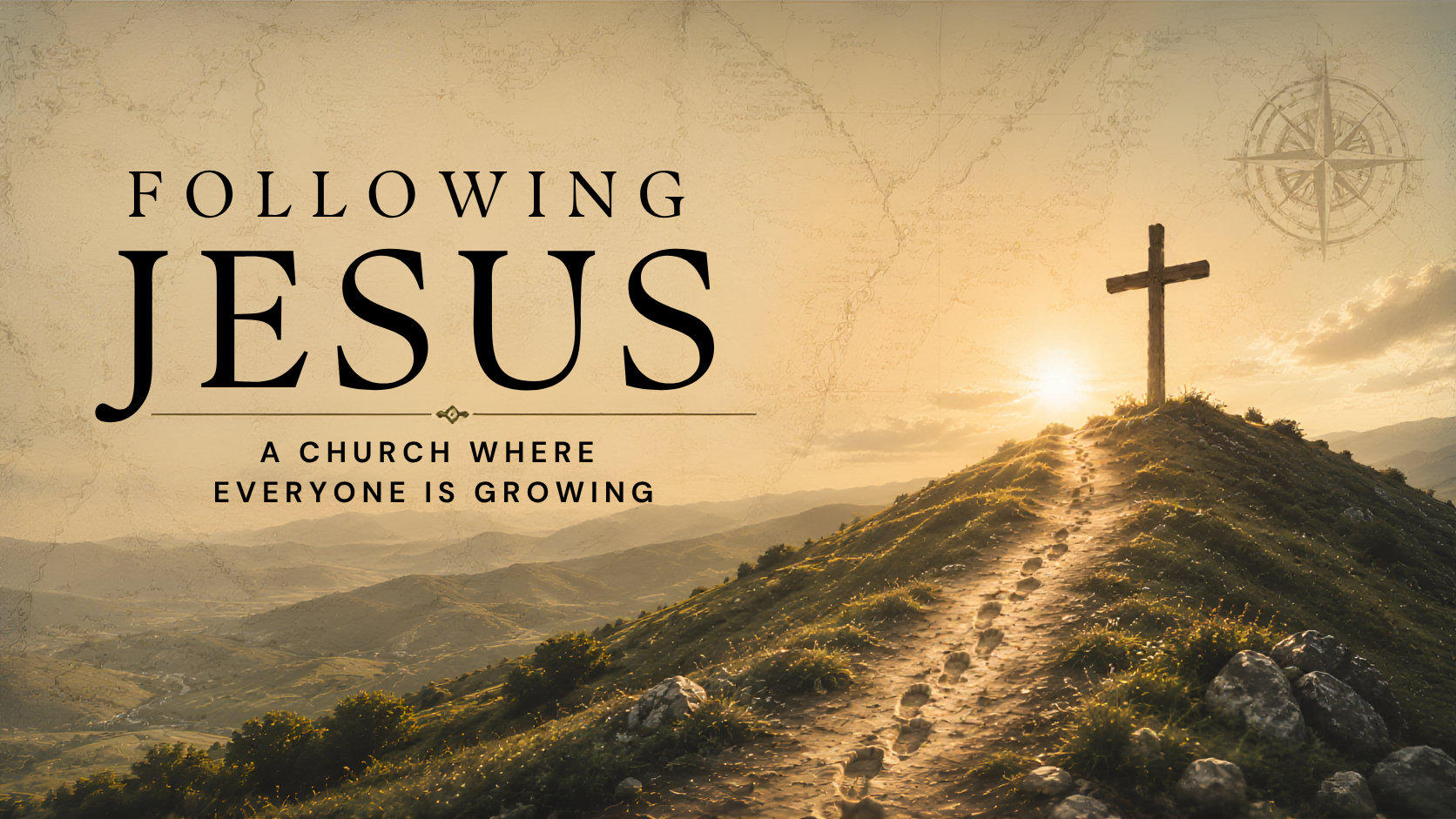
Following Jesus isn’t about arriving. It’s about allowing God’s grace to keep shaping who we are becoming.
Growth is a funny thing.
With children, we tend to notice it pretty quickly. A pair of shoes suddenly doesn’t fit. Pants that were fine a few months ago are suddenly too short. They learn something new, take on more responsibility, or begin seeing the world in a different way.
Sometimes it feels like you can almost watch them grow.
With the rest of us, growth can be a little harder to see.
The same can be true of our spiritual lives.
Following Jesus is a journey. There really isn’t a point where we get to say, “There. I’ve arrived. I’ve figured out this whole discipleship thing.”
Jesus’ invitation is wonderfully simple:
“Follow me.” — Mark 2:14
But that invitation assumes something important:
God is still working on us.
The people Jesus calls are people Jesus continues to shape.
Jesus Calls Levi Before Levi Has It All Together
In Mark 2:13–17, Jesus encounters Levi sitting at a tax booth.
That detail matters.
Jesus doesn’t meet Levi after Levi has changed his life or figured out what faithfulness will look like. Jesus meets him right in the middle of his ordinary, complicated life and says:
“Follow me.” — Mark 2:14
Jesus doesn’t say, “Clean yourself up first.”
Jesus simply says, “Follow me.”
Grace comes first.
Jesus doesn’t wait for finished people. Jesus calls people and begins forming them as they follow.
Levi’s unfinished life isn’t an exception to discipleship.
None of us begins the journey finished.
This pattern appears throughout the Gospels. Jesus calls ordinary people who still have much to learn. Peter will misunderstand Jesus, make promises he cannot keep, and even deny knowing Christ—and yet Jesus continues to form and restore him (Mark 8:31–33; Luke 22:54–62; John 21:15–19).
Discipleship has never required perfection as its starting point.
It begins with grace.
Jesus Knows We’re Still Becoming
Mark doesn’t leave Levi at the tax booth for long.
Soon Jesus is sitting at Levi’s table, surrounded by tax collectors and others whom Mark calls “sinners” (Mark 2:15–16).
When religious leaders question Jesus about the company he keeps, Jesus responds:
“Healthy people don’t need a doctor, but sick people do.” — Mark 2:17
Jesus’ welcome doesn’t depend upon anyone at that table pretending they have everything together.
In fact, Jesus seems to assume the opposite.
There are things in us that need healing. There are attitudes that need changing. There are places where we still need to learn, forgive, trust, and love.
Jesus knows all of that when he calls us.
Jesus doesn’t call us because we are finished. Jesus calls us knowing there is still work to be done.
Recognizing our need to grow isn’t evidence that we are failing at following Jesus.
It is part of following Jesus.
There are no finished people at Jesus’ table.
God Is Still Working on Us
Being unfinished doesn’t mean nothing is happening.
Paul writes to the Christians in Philippi:
“The one who started a good work in you will stay with you to complete the job.” — Philippians 1:6
There is tremendous hope in those words.
Paul doesn’t say, “You started a good work, so try harder to finish it.”
He points to what God is doing.
The God who began this work is still at work.
In the Methodist tradition, we sometimes describe this as sanctifying grace—God’s grace continuing to work within us, healing what needs healing, challenging what needs changing, and shaping us toward Christlike love.
John Wesley described the Christian life as growth in holiness and love of God and neighbor. That growth isn’t something we accomplish apart from grace. It is God’s grace working in us as we respond to it.
As Paul puts it elsewhere:
“God is the one who enables you both to want and to actually live out his good purposes.” — Philippians 2:13
Grace isn’t only what brings us to Christ.
Grace continues shaping us as we follow Christ.
Christian growth, then, isn’t about earning God’s love.
God already loves us (Romans 5:8; 1 John 4:9–10).
Growth is what God’s love begins producing in us.
So perhaps the question isn’t whether we have arrived.
Perhaps the question is whether we are still willing to be shaped.
Growth Looks Different in Different People
If we are all still being shaped, we need to remember something else:
Growth doesn’t look exactly the same in everyone.
We aren’t all starting from the same place. We haven’t had the same experiences. We don’t carry the same wounds, ask the same questions, or struggle with the same things.
The next faithful step may look very different from one person to another.
For one person, growth may mean learning to forgive (Colossians 3:13).
For another, it may mean establishing a healthy boundary.
For someone else, it may mean serving in a new way (1 Peter 4:10), admitting they were wrong (James 5:16), asking for help (Galatians 6:2), or simply learning to trust God one day at a time (Matthew 6:34).
Growth isn’t a competition.
Instead of measuring our faith against someone else’s journey, we can ask:
Where is God’s grace inviting me to grow?
Paul offers us an important sign of what that growth might look like:
“This is my prayer: that your love might become even more and more rich.” — Philippians 1:9
One of the signs that God’s grace is shaping us is that love is growing.
Maybe we are becoming a little more patient.
A little more willing to listen.
A little slower to judge.
A little quicker to notice someone who is hurting.
A little more courageous about doing what is right.
Not all at once. Not perfectly.
But over time, something begins to change.
Paul describes the fruit of God’s Spirit as “love, joy, peace, patience, kindness, goodness, faithfulness, gentleness, and self-control” (Galatians 5:22–23).
The grace we have received begins shaping the people we are becoming.
So perhaps one way to ask, “Am I growing in my faith?” is to ask another question:
Is love growing in me?
We Help One Another Grow
Paul’s prayer in Philippians isn’t simply about individual growth.
He is writing to a community. He gives thanks for their partnership (Philippians 1:3–5). He prays for them. He speaks about the work God is doing among them.
Following Jesus was never meant to be something we do alone.
We need one another.
Scripture repeatedly describes Christian discipleship as a shared life. We are called to “encourage each other and build each other up” (1 Thessalonians 5:11), to “carry each other’s burdens” (Galatians 6:2), and to consider how we can “motivate each other to show love and to do good works” (Hebrews 10:24).
A healthy church, then, isn’t simply a building filled with individuals working on their own spiritual lives.
It is a community where we help one another grow.
It is a place where questions can be asked without embarrassment.
Where mistakes don’t have to define us.
Where someone who has followed Jesus for fifty years can still learn something new, and someone who is just beginning doesn’t have to pretend to have everything figured out.
It is a place where we encourage rather than compare.
Sometimes helping someone grow means encouraging them. Sometimes it means speaking “the truth in love” (Ephesians 4:15). Sometimes it means walking beside someone as they take a difficult step.
But we do all of this remembering that God is working on all of us.
We don’t need everyone to be in the same place.
We need to remain open to where God’s grace is leading next.
What Is Your Next Faithful Step?
That leaves each of us with a question:
What is my next faithful step?
Not someone else’s next step.
Mine.
Where is Christ calling me to follow?
Where is grace inviting me to grow?
Who has God placed around me to encourage me along the way?
Because we are all still becoming.
And we don’t have to become alone.
A Table for People Still Becoming
There is one more beautiful detail in Levi’s story.
Jesus is at the table.
Jesus is eating with people whose lives are unfinished.
That is a powerful image of grace—and it points toward something Christians continue to experience at the Communion table.
We don’t come to Communion because we have grown enough, figured everything out, or earned our place.
We come because Christ invites us.
In the United Methodist tradition, the Communion invitation describes Christ as inviting to the table all who love Christ, earnestly repent of their sin, and seek to live in peace with one another.
We come as people still learning.
Still growing.
Still being shaped by grace.
We come honestly, bringing the places where we still need healing, forgiveness, and change.
And we trust the promise:
“The one who started a good work in you will stay with you to complete the job.” — Philippians 1:6
God is not finished with us.
So perhaps the most important question isn’t:
“Have I arrived?”
Perhaps it is:
“Where is God’s grace inviting me to grow next?”
Whatever your answer may be, remember the table where Jesus sat with Levi.
Christ is still calling.
Grace is still working.
Love is still growing.
And nobody here is finished.
A Prayer for People Still Becoming
Gracious God,
thank you for meeting us where we are and loving us before we have everything figured out. Continue the good work you have begun in us. Heal what needs healing. Challenge what needs changing. Teach us where we still need to learn. Grow within us the love of Christ—for you, for our neighbors, and even for those we find difficult to love.
Give us courage to take our next faithful step, patience with those whose journey looks different from ours, and grace to encourage one another along the way.
Keep shaping us until your love becomes more fully visible in the way we live.
Amen.
Scripture for further reflection: Mark 2:13–17; Philippians 1:3–11; Philippians 2:12–13; Galatians 5:22–23; Ephesians 4:15–16; Hebrews 10:23–25.


