
Last week, we heard Jesus invite us not to be consumed by worry. He reminded us that our heavenly Father knows what we need before we even ask. Our hope doesn’t rest in our ability to predict tomorrow but in the faithfulness of the God who is already there.
But trusting God becomes much more difficult when the future is uncertain.
Most of us don’t mind change when we choose it. We welcome a new grandchild, a new home, a new opportunity, or a long-awaited answer to prayer. But change we didn’t ask for – that’s different. A difficult diagnosis. Retirement. Children moving away. The loss of someone we love. A changing community. A changing church. Those moments can leave us wondering what comes next.
When the future feels uncertain, it is easy to look backward. We remember seasons that seemed simpler. We remember how things used to be. Sometimes the past begins to look safer than the future, even if it wasn’t.
That is not just our story. It has always been the story of God’s people.
We heard that story earlier in our reading from Exodus. Israel had been set free from slavery, yet before long they began looking back toward Egypt. Freedom had led them into a wilderness they had never expected, and suddenly the familiar past seemed more attractive than the unknown future.
The disciples in today’s Gospel find themselves in another wilderness. Thousands of people are gathered. The day is ending. The food is gone. The future, at least from their perspective, looks like there isn’t enough.
Two different stories. Two different generations. Yet they ask the same question: Can God really be trusted with what comes next?
As we just sang, “Open my eyes, that I may see.” Perhaps that is the prayer we need today. Because sometimes God doesn’t immediately change our circumstances. Sometimes God first opens our eyes to see God’s faithfulness already at work.
Matthew 14:13-21
Fear Looks Back
This is one of the best-known miracles in the Gospels. Many of us have heard it since we were children. Because it’s so familiar, we can easily miss the tension in the story.
Imagine standing there with the disciples. It has been a long day. The crowds have grown, evening is approaching, and everyone is far from home. There is no easy solution.
The disciples look at the situation and reach what seems like the only reasonable conclusion: “Send the crowds away so they can buy food for themselves.”
It’s a practical suggestion. But Jesus responds with words that must have left them speechless: “They don’t need to go away. You give them something to eat.”
The disciples look at what they have – five loaves, two fish, and thousands of hungry people. From their perspective, it simply isn’t enough.
We’ve all had moments like that. We look at what lies ahead, take inventory of our resources, and quietly conclude, There isn’t enough. Not enough time. Not enough certainty about the future.
That feeling isn’t unique to the disciples. It’s the same struggle we heard earlier in Exodus.
After God delivered Israel from slavery and led them into the wilderness, hunger set in, and fear began to reshape their memories. Suddenly Egypt didn’t seem so bad. They forgot the cruelty of slavery and remembered only the food they had eaten.
God Provides Daily Bread
The remarkable thing about Exodus is that God doesn’t respond to Israel’s fear with anger. God responds with provision. God says to Moses: “I am going to rain down bread from heaven for you.”
What an astonishing promise. The people have questioned God’s care and doubted God’s intentions. Yet God’s response is not condemnation. It is daily bread.
Notice how God chooses to provide. God doesn’t give them enough manna for years. God gives them enough for one day. Each morning they gather what they need. If they try to save it for tomorrow, it spoils.
Every sunrise becomes an invitation to trust. Will God be faithful today? And each day they discover the same answer: God is faithful.
There is a gentle wisdom here. We want God to remove all uncertainty. We want guarantees about tomorrow. Instead, God offers something better – God’s presence and enough grace for today.
Perhaps that is why Jesus taught his disciples to pray, “Give us this day our daily bread.” He wasn’t introducing a new idea. He was reminding God’s people that the God who fed Israel in the wilderness is the same God who still meets God’s people one day at a time.
That brings us back to the hillside where Jesus is surrounded by thousands of hungry people. The setting has changed. But the question has not.
Can God be trusted when there doesn’t seem to be enough?
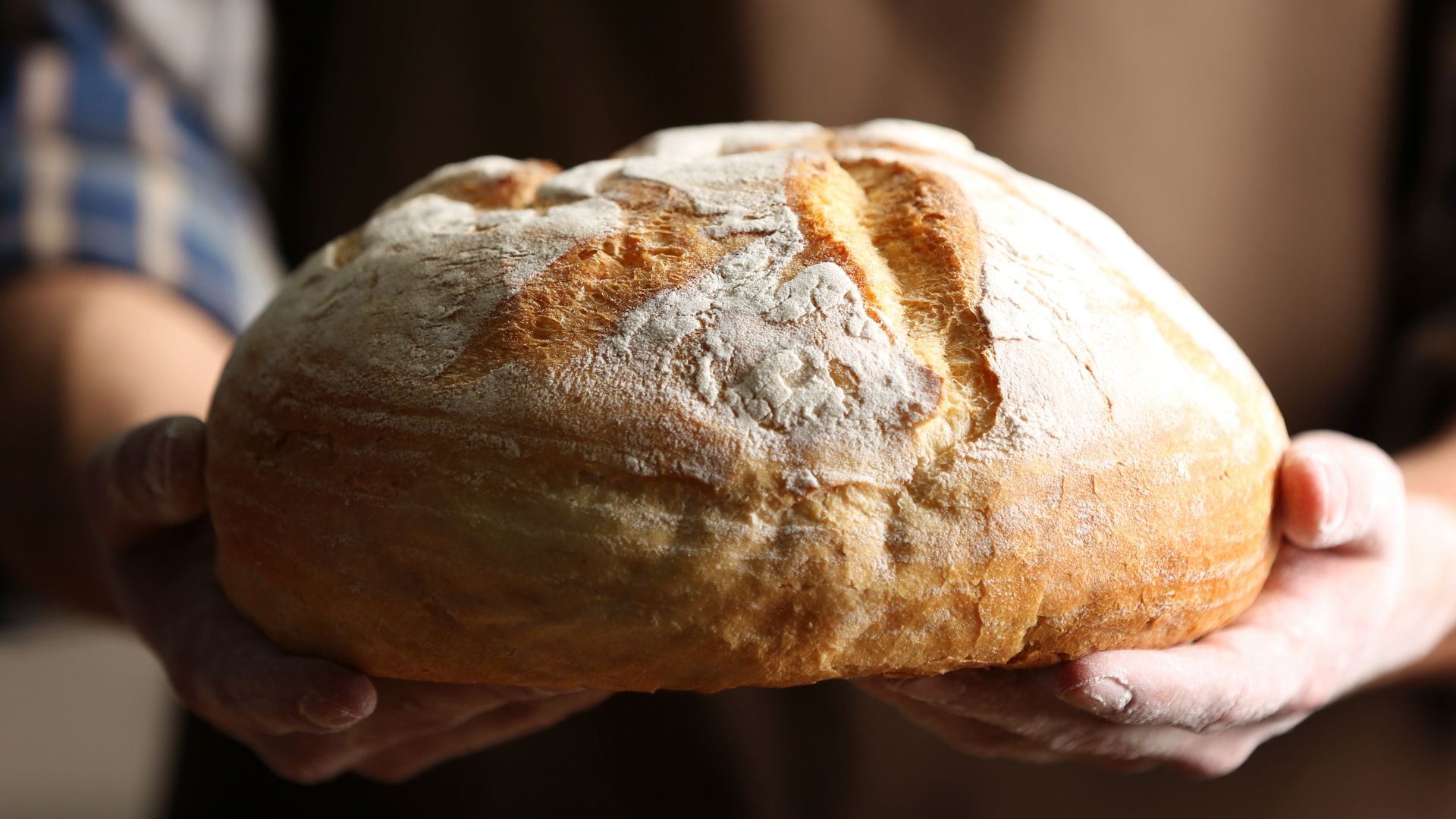
Once again, God answers – not with an explanation, but with bread.
Jesus Sees Possibility
The disciples have seen Jesus heal the sick. They have watched the crowds gather. Now evening is coming, and they see only one responsible solution. “Send the crowds away.”
No one could blame them. They know exactly how much food they have – five loves, two fish and thousands of hungry people. The numbers simply don’t add up. The disciples aren’t lacking compassion. They’re lacking imagination. Their calculations are correct. Their conclusion is not. Because they’ve forgotten one thing. Jesus is standing right there.
N.T. Wright reminds us that this miracle is about far more than feeding hungry people. Jesus is revealing that God’s kingdom has arrived. In God’s kingdom, scarcity does not have the final word. God’s abundance breaks into ordinary life in ways no one expects.
That’s why Jesus doesn’t begin by asking, “What don’t you have?” Instead, he asks, “What do you have?” Five loaves. Two fish. It wasn’t much. But it was enough to place into the hands of Jesus.
That may be one of the hardest lessons for us to learn. We naturally focus on what we lack. Jesus invites us to notice what God has already placed in our hands.
Throughout Scripture, God has a habit of beginning with what seems too small – a shepherd’s staff, a widow’s jar of oil, a young boy’s lunch. Time and again, God uses ordinary gifts in extraordinary ways.
That’s where these stories meet our own. We may not be feeding five thousand people, but we know what it feels like to wonder if there will be enough.
The disciples looked at what they had and saw limits. Jesus looked at what they had and saw possibilities. The difference wasn’t simply the bread. The difference was placing what little they had into the hands of Jesus.
Trust Opens the Way Forward
This is where Christian Joy becomes different from ordinary optimism. Optimism depends on believing everything will work out the way we hope. Christian Joy depends on knowing the One who remains faithful whether life unfolds as we expect or not. Joy grows where trust grows.
So what does this mean for us?
Most of us don’t wake up wondering how we’re going to feed five thousand people. But we do wake up wondering about the future – our health, our families, our finances, and even the future of our church.
Those are real questions. Scripture never tells us to ignore them. It reminds us that our future is held by the God whose faithfulness has never failed.
Think about the stories we’ve heard today. Israel couldn’t see tomorrow’s manna. The disciples couldn’t see a meal for thousands. In both stories, God’s people saw what was missing. God saw what God’s grace could do through ordinary gifts placed in willing hands.
Perhaps that’s the invitation for us – not to deny the challenges ahead, but to remember that God’s faithfulness has always been greater than our fears.
Earlier we sang, “Great is Thy Faithfulness.” Notice what we don’t’ sing. We don’t sing, “Great is my confidence.” We don’t sing, “Great is my ability.” We don’t even sing “Great is my faith.” We sing, “Great is Thy Faithfulness.”
Our hope has never rested on the strength of our faith. It rests on the faithfulness of God. So instead of asking, “What if there isn’t enough?” perhaps we begin asking, “What has God already placed in our hands?”
One Faithful Next Step
This week, whenever you find yourself worrying about the future, I want to invite you to pause and ask two simple questions.
What has God already provided?
And…
What is the next faithful step? Not the next ten steps. Not next year. Just the next faithful step. That’s how Israel crossed the wilderness. That’s how the disciples learned to follow Jesus. And that’s how most of us discover God’s faithfulness – not all at once, but one day, one step, one act of trust at a time.
The God Who Goes Before Us
As we’ve traveled through this series together, we’ve been rediscovering Christian Joy. In the first week, we discovered that our joy begins because God delights in us. Last week, we discovered that the God who delights in us is also the God who cares for us.
Today we’ve discovered one more truth. The God who delights in us… the God who cares for us… is also the God who goes before us.
We do not know everything the future holds. But we know the One who has been faithful in every generation. The God who fed Israel in the wilderness. The God who fed the crowds beside the sea. The God who has carried this congregation through seasons of challenge and seasons of blessing. That same God is already waiting in tomorrow.
So we move into the future – not because we have all the answers, but because we know the heart of the One who leads us there.
And that is why Christian Joy can face an uncertain future with confidence. For our confidence is not in ourselves. Our confidence is in the God whose mercies are new every morning… whose compassion never fails, and whose faithfulness is and always will be great.


