Who Is God? Finding Evidence in Love

This past Sunday, we began our Lenten sermon series, “Questions to God,” by wrestling with one of the biggest and most fundamental questions of faith: Who is God? And does God even exist?

For centuries, people have sought proof of God’s presence. We long for certainty, something tangible we can see, hear, or touch. But faith doesn’t always work that way. Instead of giving us definitive answers, God gives us an invitation—an invitation to love.

Seeking God in Love

Psalm 103 speaks of a God who is compassionate, slow to anger, and overflowing with steadfast love. But how do we really know this is true? If we can’t physically see God, how can we be sure God is real?

1 John 4 offers a bold response: “God is love.”

This means that whenever we experience true, selfless love, we are catching a glimpse of God. We see God in the embrace of a friend who comforts us in sorrow, in the patience of a parent teaching a child, in the kindness of a stranger who extends help without expectation.

This idea is echoed in the words of Mother Teresa when a journalist once asked her, “Where is God?”

She replied:
“God is in the smile you give a child. God is in the hand you hold of someone who is suffering. God is in the small acts of love that go unnoticed but make all the difference in the world.”

Her response is simple, yet profound: if you want to see God, look for love.

Is Love Really Enough?

But that raises a difficult question: Is love really enough?

If we’re honest, sometimes we want more than just an idea. We want certainty. We want proof. And we are not alone in this struggle—the Bible is full of people who asked for the same thing.

  • Moses asked to see God’s glory.
  • The disciples wanted Jesus to show them the Father.
  • Thomas refused to believe in the resurrection until he could touch Jesus’ scars.

Yet, in all these cases, God’s response was not always physical proof but relationship, presence, and love.

1 John 4:12 reminds us: “No one has ever seen God. But if we love each other, God remains in us and God’s love is made complete in us.”

To know love is to know God.

Jesus: The Ultimate Revelation of God’s Love

But how do we know that love comes from God? Couldn’t love just be a human instinct, a biological reaction, or a cultural value we’ve learned?

This is where Jesus changes everything.

1 John 4:9-10 tells us that God’s love was made known through Jesus.

Yes, people can experience love apart from faith, but in Jesus, something radical and new happened. His love went beyond emotion, beyond instinct, beyond even survival.

His love was:

  • Sacrificial – Giving up his own comfort and safety for the sake of others.
  • Self-giving – Holding nothing back, even his own life.
  • Countercultural – Welcoming outsiders, forgiving enemies, and loving without condition.

Jesus showed a love that:

  • Forgave even those who crucified him.
  • Healed the broken.
  • Welcomed those the world had rejected.
  • Gave everything—even his own life—for the sake of others.

And after his death, something remarkable happened.

A New Kind of Community

A new community emerged—a group of people who had once been afraid but were now radically loving, deeply unified, and completely transformed.

In Acts 4:32-36, we see what this community looked like:

  • They shared everything.
  • They cared for the poor.
  • They lived without fear.
  • They were freed from oppressive systems.

This was not just a social movement—it was the love of God at work.

And that same love is still at work today.

Where Have You Seen God’s Love?

Love is not just an abstract concept—it’s something deeply personal.

For me, one of the greatest examples of love in my life was my grandmother. I met her for the first time when I was three years old, and I will never forget that moment. As soon as she saw me and my mother, she wrapped us both in her arms, as if we had always belonged to her.

Never once did she make me feel like an outsider. She loved me as if I was her own. It was as if, before that moment, I had been lost—but in her embrace, I had finally found home.

That kind of love tells you that you belong, that you are wanted, that you are cherished.

And when I look back, I realize—that kind of love wasn’t just human love. That was divine.

A Call to Live Differently

1 John 4:18 says, “There is no fear in love, but perfect love drives out fear.”

We live in a world that is often driven by fear—fear of failure, fear of rejection, fear of those who are different from us, fear of not having enough.

But what if we, as a church, chose to abide in love instead?
What if we didn’t let fear have the final word?
What if, instead of trying to prove ourselves, defend ourselves, or protect ourselves, we simply loved?

Imagine What Could Happen…

  • Instead of judging, we showed grace.
  • Instead of reacting in anger, we responded with patience.
  • Instead of assuming the worst, we gave the benefit of the doubt.
  • Instead of withholding forgiveness, we extended it freely.

What would our families look like if we chose love over fear?
What would our workplaces feel like if we lived as people of grace?
What would our neighborhoods, schools, and communities become if we truly believed that love—not power, not control, not fear—is the greatest evidence of God?

The Challenge for This Week

So, here is the challenge:

  • Where have you seen love at work this week?
  • Where is God calling you to be a reflection of that love?
  • What fear, bitterness, or hesitation do you need to let go of so you can love more freely?

Because the world doesn’t just need to hear about love.
The world needs to see it.
The world needs to experience it.
The world needs to find home in it.

And that starts with us.

Let’s be a church where love is so bold, so undeniable, that when people look at us, they don’t just see us—they see God.


Closing Prayer

Loving God,
We may not see you with our eyes, but we see you in the love that surrounds us.
Help us to trust that love is not just an emotion but a reflection of your presence.
Make us people who love boldly, without fear, without hesitation.
Let our lives be a witness to your goodness, your mercy, and your grace.
In Jesus’ name, Amen.


Want to Dive Deeper?

  • Reflect: Write down one way you have seen love in action today.
  • Act: Who in your life needs to experience God’s love through you? Take one intentional step to show them grace, kindness, or compassion this week.

***
Hands to Serve, Hearts to Love

1 The earth is the LORD’s and everything in it,
the world and its inhabitants too.
2 Because God is the one who established it on the seas;
God set it firmly on the waters.
3 Who can ascend the LORD’s mountain?
Who can stand in his holy sanctuary?
4 Only the one with clean hands and a pure heart;
the one who hasn’t made false promises,
the one who hasn’t sworn dishonestly.
5 That kind of person receives blessings from the LORD
and righteousness from the God who saves.
6 And that’s how things are
with the generation that seeks him—
that seeks the face of Jacob’s God. ~Psalms 24:1-6

Psalm 24 reminds us that the earth belongs to God, and so do we. With that truth comes responsibility—to care for creation and for each other. The psalm also asks, “Who may stand before the Lord?” The answer? “Those with clean hands and pure hearts.”

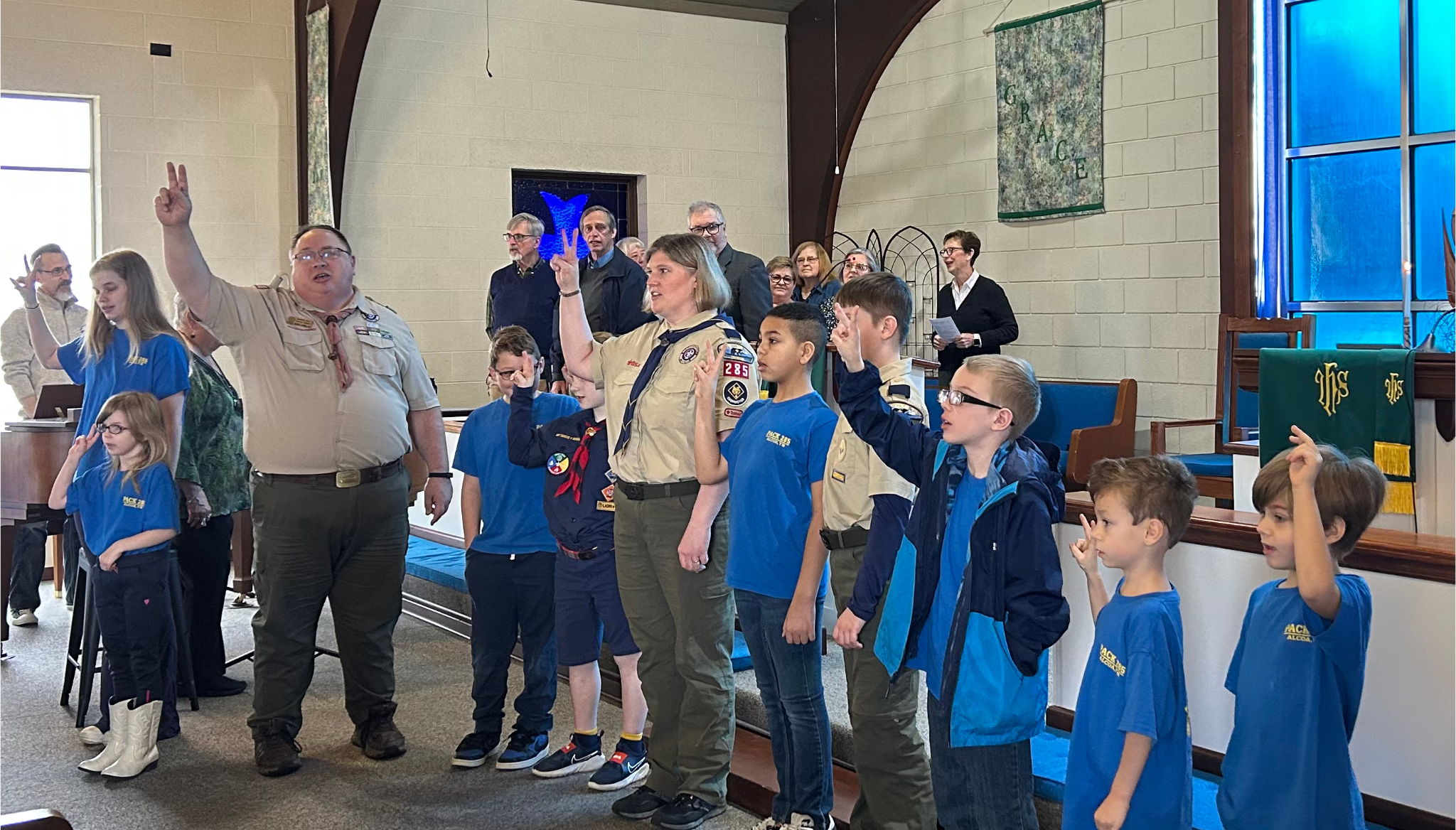
On Sunday, we celebrated Scout Sunday, reflecting on these values of stewardship, service, and honor. The Scout Oath and Law call young people to live with integrity, to help others, and to be reverent. These same principles are at the core of our faith – because living a life that honors God isn’t just about what we believe; it is about how we live.

But what does this look like in our daily lives? How do we live with clean hands – serving others with purpose? How do we cultivate pure hearts – loving God fully and loving our neighbors with sincerity?

For that answer, we turn to the words of Jesus in the Gospel of Matthew. When asked what commandment is the greatest, Jesus does not respond with a long list of rules or religious rituals. Instead, he gives us something deep yet simple.

Love the Lord God with all your heart, soul, and mind. And love your neighbor as yourself.

If Psalm 24 calls us to have clean hands and pure hearts, then Matthew 22 shows us what that truly means: our hands are meant to serve, and our hearts are meant to love…

36 “Teacher, what is the greatest commandment in the Law?”
37 He replied, “You must love the Lord your God with all your heart, with all your being, and with all your mind. 38 This is the first and greatest commandment. 39 And the second is like it: You must love your neighbor as you love yourself. 40 All the Law and the Prophets depend on these two commands.” ~Matthew 22:36-40

Sometimes, we care a lot about how we look on the outside – what we wear, what we say, and what other people think about us. It is like spending all our time cleaning a mirror to make it shiny, but never actually getting ourselves ready. But Psalm 24 reminds us that what really matters is what is inside – having clean hands and a pure heart.

Now, let’s think about work gloves. Gloves aren’t meant to stay clean. A brand-new pair of gloves sitting on a shelf look nice, but they aren’t fulfilling their purpose. Gloves are meant to get dirty, worn, and used for work. They are meant for planting gardens, building homes, helping others – they are meant for service.

Our faith isn’t about looking good – it is about getting our hands to work in service. That is exactly what Jesus tells us in Matthew 22: love God with everything you have, and love your neighbor as yourself. That love isn’t just a feeling – it’s an action. Just like a pair of gloves isn’t useful unless it is used for work, our faith isn’t complete unless it is put into action through serving others and living with integrity.

Psalm 24 tells us that only those with clean hands and pure hearts may stand before God. But clean hands don’t mean hands that have never touched dirt. They mean hands that have worked, helped, and served. Hands that have been used for Good.
Scouts have a simple slogan: “Do a Good Turn Daily.” It is a reminder that acts of service don’t have to be big projects, big sacrifices, or life-changing actions.

But often, love is seen in the small things. Holding the door for someone. Saying thank you and showing kindness. Sitting with someone who is alone. Picking up trash, even if you didn’t drip it. Calling a friend or relative who might be lonely. You don’t need to change the whole world to show love – you just need to change a moment for someone.

One day, a man was walking down the street when he saw a young boy helping an older man carry groceries to his car. The boy wasn’t asked – he just saw someone struggling and stepped in. The man watching smiles and said, “that was very kind of you!” The boy shrugged and said, “IT’s just what we are supposed to do, right?”

If clean hands mean serving with purpose, then a pure heart means serving with the right motives. Jesus says the greatest commandment is to love the Lord your God with all your heart, soul, and mind. Loving God isn’t just about believing the right things – its about giving our hearts fully to God in everything we do.

Do we help others so that people will see us? Do we do good things only when we will get something in return? Or do we love and serve because God loves us first Sometimes, we get so caught up in how we look or what we get out of it that we forget the real purpose of love and service. 1 Corinthians 13:3 says, “If I give away everything that I have and hand over my own body to feel good about what I’ve done but I don’t have love, I receive no benefit whatsoever.” Serving without love is just empty action.

We have spent time looking at Psalm 24’s call to have clean hands and pure hearts and Jesus’ command in Matthew 22 to love God and love our neighbor. Now we will bring it all together.
In Matthew 22:40, Jesus says, “All the Law and Prophets hang on these two commandments.”
This means that everything God has ever taught us – every command, every law, every act of worship – boils down to two things: Loving God with all we are and loving others as ourselves. It is that simple. If we get this right, everything else falls into place. But here is the challenge. We can do a lot of things right and still miss the point if we don’t love.

We can attend church every Sunday but if we don’t love our neighbor, we have missed the point. We can pray beautiful prayers but if we refuse to help someone in need, we have missed the point. We can know every Bible verse by heart, but if we don’t show kindness, patience, and generosity, we have missed the point. We can follow all the rules but if our hearts aren’t filled with love for God and others, we have missed the point. This is why Jesus places love at the center of our faith. Without it, everything else is empty.

Let’s return to the work gloves analogy. If we leave our gloves on a shelf, clean and unused, they serve no purpose. If we only wear them to look the part but never do the work, we aren’t really serving. But if we put them on, get to work, and serve with love, we are fulfilling our purpose. This is what Jesus calls us to do.

Are we just polishing the mirror – worried about how we appear to others? Or are we putting on our gloves and getting to work – showing love in action? Faith is meant to be lived out. Our love for God is meant to be seen in how we treat others. Clean hands and pure hearts aren’t about being perfect. They are about being willing to serve, love, and follow God with sincerity.

We began today with a question from Psalm 24: “Who may ascend the mountain of the Lord? Who may stand in his holy place?” And we found our answer: Those with clean hands and pure hearts. Then, we heard the words of Jesus in Matthew 22: “Love the Lord your God with all your heart, soul, and mind, and love your neighbor as yourself.” This is what truly matters. This is what we are called to do. But where do we go from here? How do we actually live this out?

The Scout motto is “Be Prepared.” A scout is always ready – ready to help, ready to serve, ready to do what is needed. As followers of Christ, we must also be prepared – prepared to love when it is inconvenient, prepared to serve when it is not easy, prepared to answer when God calls. Being prepared doesn’t mean waiting for a big, perfect opportunity – it means being ready every day to do good wherever we are. Are we prepared to love? Are we prepared to serve? Are we prepared to live as Jesus taught?

The Cub Scout motto is “Do Your Best.” Jesus doesn’t ask us to be perfect – he asks us to do our best. Loving God with all our heart, soul, and mind doesn’t mean we have to get everything right – it means we give our best effort every day. Loving our neighbor doesn’t mean we always have to do something huge – it means we do what we can, when we can, with a willing heart.

So the challenge is simple:

Do your best to serve. Do your best to love. Do your best to live as Jesus calls us to.

Imagine what our world would look like if every person committed to: Keeping their hands clean by using them for service. Keeping their hearts pure by filling them with love. Being prepared to answer when God calls. Doing their best to love God and love their neighbor. If we lived this way, we wouldn’t just hear the greatest commandments – we would live them.

So, let’s make a commitment:

With our hands, we will serve. With our hearts, we will love. We will be prepared. We will do our best.

And when we do, we will truly be the kind of people God calls us to be. Amen.